
English 
Tel: +86-592-6016338
WhatsApp: +8613859908475
WhatsApp: +8613859908475
Add: No. 16 Yifa 1st Road, Yifa Industrial Park, Dushi Village, Pingtan Town, Huiyang District, Huizhou, Guangdong, China


Views: 0 Author: Site Editor Publish Time: 2026-10-18 Origin: Site


Picture this common field scenario. A newly installed roadside drainage trench completely fails within its first few years. Surface water pools across the asphalt. Subgrade materials wash out entirely. The structural integrity of a million-dollar roadway is suddenly at risk.
When excavation crews dig their shovels into the failed trench to investigate, they expect to find obvious trauma. They anticipate shredded material, massive punctures from sharp rocks, or a crushed pipe. Instead, they uncover something baffling. The barrier wrapping the aggregate shows absolutely no signs of physical damage. It looks perfectly fine.
How can a drainage system fail so catastrophically when its protective barrier remains visually pristine? From a frontline engineering perspective, the core problem lies in a fundamental misunderstanding of material performance. Physical integrity simply does not equal hydraulic performance. A barrier can be structurally sound and hold back dirt flawlessly, while simultaneously acting as a watertight seal that suffocates the entire system.
Solving this issue requires a strict shift in how materials are specified. Moving away from outdated assumptions and selecting the correct nonwoven geotextile fabric is the only proven method to ensure long-term success. You must meticulously match its hydraulic properties to the specific soil conditions of the site. This guide will uncover the hidden, microscopic causes of roadside drainage failure and provide an evidence-based approach to selecting the precise materials required for your next infrastructure project.
Physical strength is deceiving: Field excavations frequently reveal materials that look perfectly intact structurally while being completely compromised hydraulically. This leads to total system collapse.
Clogging vs. Blinding: Engineering success requires understanding the distinct difference between fine soils caking on top of the surface and particles becoming permanently trapped inside the fiber matrix.
Material selection is critical: Specifying a tightly woven material instead of a dedicated porous medium remains the leading cause of subgrade saturation and trench failure.
Permittivity matters: Long-term performance relies strictly on matching the Apparent Opening Size and water flow rate to the specific particle size distribution of the local soil.
Quality ensures lifespan: Investing in highly flexible, chemically resistant polyester materials guarantees maximum project lifespan and drastically reduces the probability of costly future rework.
Human intuition expects visible damage when a system breaks down. If water is not flowing into the perforated pipe, the logical assumption is a physical breach allowing mud to fill the aggregate. When structural damage is absent, contractors often incorrectly place the blame on crushed drainage pipes or improperly graded gravel.
In reality, the actual culprit is usually hydraulic failure. This silent killer occurs at the exact moment water can no longer pass through the barrier at the required engineering design rate. The material is technically doing half its job by retaining the earth. However, it has completely stopped letting water pass. Consequently, groundwater and surface runoff back up. Hydrostatic pressure builds rapidly, forcing moisture into the road base. This inevitably leads to asphalt degradation, pothole formation, and eventual structural collapse.
A frequent error in civil construction procurement is over-specifying tensile strength while simultaneously ignoring critical hydraulic properties. Project managers often look at specification sheets and assume that a higher grab tensile strength rating inherently makes a product superior for all applications.
While immense tensile strength is an absolute necessity for subgrade stabilization and load distribution under heavy traffic, it is largely irrelevant for subsurface water management. Manufacturing processes that maximize physical strength often do so by reducing open area. Selecting a material based solely on its resistance to tearing creates a structurally sound but hydraulically dead barrier. This seals moisture inside the trench rather than allowing it to filter through safely.
Blinding is a surface-level phenomenon that rapidly destroys the functionality of a drainage system. It occurs when fine soil particles—predominantly cohesive clays and fine silts—accumulate directly on the upstream surface of the filtration layer. Because these microscopic particles are cohesive enough to stick together, they form a dense, impermeable crust over the material.
Once this blinding layer reaches a certain thickness, it completely seals the surface. Water is physically blocked from entering the trench, rendering the entire aggregate and pipe system beneath it useless. Upon excavation, the material often feels stiff. It resembles mud-caked cardboard rather than a flexible textile.
Furthermore, while blinding happens on the surface, clogging is an insidious internal failure mechanism. This occurs when fine particles penetrate the outer boundary but become permanently wedged within the internal fiber matrix. Over time, as flowing water carries more particles into the core, the internal voids become completely filled.
The permeability gradually drops to zero. Unlike blinding, where the crust might occasionally be dislodged by shifting earth, internal clogging is irreversible. A clogged barrier acts indistinguishably from a solid plastic sheet. It completely halts the necessary flow of groundwater away from the foundation.
Hydraulic gradients and water velocity heavily influence the rate at which these failures occur. During heavy flash floods or periods of fluctuating groundwater tables, the velocity of moisture moving through the surrounding earth increases dramatically. This higher velocity generates sufficient kinetic energy to detach fine particles from the soil matrix, transporting them directly into the filtration layer.
If the chosen medium lacks the appropriate three-dimensional structure to handle this dynamic particle movement, the rapid influx of fines will accelerate the clogging process. Proper engineering requires anticipating these peak flow events and selecting a filtration medium capable of maintaining permeability under intense pressure.
Woven materials are manufactured by weaving individual threads or slit-film tapes together on a large industrial loom. The resulting product resembles a heavy-duty plastic tarp. Their primary engineering function is reinforcement and separation. By providing exceptional tensile strength with very little elongation, they excel at distributing heavy mechanical loads over weak subgrades, preventing rutting in unpaved roads.
In contrast, their flat, two-dimensional structure provides a remarkably low percentage of open area. This often falls below four percent. This makes them highly susceptible to blinding. Wrapping a roadside drainage trench in a woven material is a catastrophic engineering mistake. It will almost certainly fail to pass water efficiently over the long term.
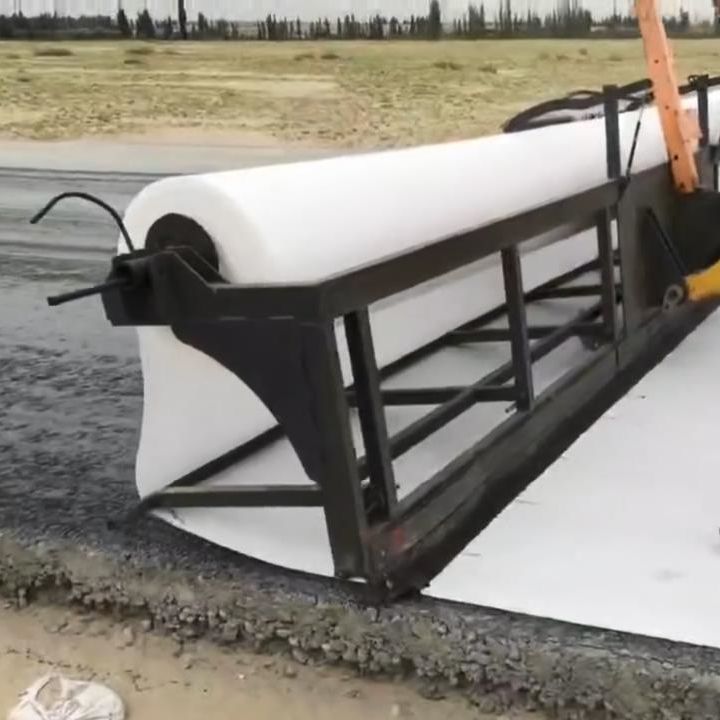
To achieve long-term success, the industry standard relies on nonwoven manufacturing processes. These materials are typically needle-punched. This is a dynamic process where thousands of barbed needles mechanically entangle synthetic fibers together, creating a thick, felt-like, three-dimensional texture.
This intricate structure allows moisture to pass through from multiple angles. At the same time, it creates a tortuous path that traps larger soil particles while allowing the absolute finest dust to wash through without immediately losing overall permeability. This delicate balance makes it the ultimate filtration medium.
| Feature | Woven Geotextile | Nonwoven Geotextile |
|---|---|---|
| Manufacturing Process | Woven on a loom with a flat structure | Needle-punched entangled fibers with a deep porous structure |
| Physical Appearance | Plastic tarp-like, smooth, rigid | Felt-like, textured, highly flexible |
| Primary Engineering Function | High-strength reinforcement | Filtration and high-flow drainage |
| Water Permeability | Very low | Very high |
| Suitability for Trench Drains | Poor - High risk of blinding | Excellent - Industry Standard |
Recent geotechnical engineering analyses reveal a shifting paradigm in infrastructure design. This shift is heavily influenced by changing global weather patterns. As regions experience more frequent and severe flash flooding events, the volume of surface runoff infiltrating road subgrades has skyrocketed. Traditional drainage designs, which often relied on minimum-spec materials to cut upfront costs, are failing at unprecedented rates under these extreme hydrostatic pressures.
Today, industry experts and regulatory bodies are advocating for a hydraulic-first approach to specification. Municipal engineers are increasingly rejecting tightly woven materials for subsurface drainage. Standard operating procedures now mandate high-permittivity, three-dimensional nonwovens. This trend underscores a broader industry realization. Investing in specialized filtration media upfront is exponentially cheaper than funding emergency pavement rehabilitation caused by premature subgrade saturation.
The foundation of any successful filtration design lies in the Apparent Opening Size. This metric represents the approximate maximum particle size that can physically pass through the matrix. The golden rule of geotechnical filtration requires a delicate balance. The opening size must be small enough to retain the majority of the surrounding earth, preventing structural collapse. Simultaneously, it must be large enough to allow liquid and microscopic fines to pass through freely.
If the opening size is too small, the surface will blind rapidly. Conversely, if it is too large, excessive dirt will wash through. This causes the surrounding ground to subside and potentially clogs the perforated pipe inside the trench.
Different geological compositions demand highly specific physical properties. For instance, standard applications often call for a 200g per square meter specification. There is no universal solution for all environments, but selecting the right road construction geotextile is the first step.
Sandy and Gravelly Soils: These environments feature larger, non-cohesive particles. The primary risk here is piping. This is a phenomenon where continuous flow washes the sand through the barrier, creating dangerous subsurface voids next to the roadway. A strictly controlled opening size is required to hold the sand in place while managing high volumes of liquid.
Silty and Clay Soils: Highly cohesive, fine-grained soils pose a massive blinding risk. They require a highly permeable nonwoven medium with a larger open area. The goal is to allow the initial flush of microscopic fines to pass through and wash away. This eventually forms a natural, stable soil filter bridge just outside the fabric surface.
Beyond particle retention, engineers must evaluate two critical flow metrics to ensure longevity. Permittivity refers to the rate at which liquid flows directly through the cross-plane of the material under a specific hydraulic head. High permittivity is non-negotiable for trench wraps. Transmissivity refers to the ability to channel liquid within its own plane. While slightly less critical for basic trench wraps, high transmissivity is vital for retaining wall applications where moisture must travel along the barrier itself to reach an outlet.
Once buried deep beneath a highway, these materials are subjected to a harsh, unseen environment. While protected from ultraviolet degradation, they face continuous chemical and biological assaults. Road runoff frequently contains heavy concentrations of de-icing salts, automotive oils, and hydrocarbon pollutants that seep down into the trench.
Depending on local water chemistry, iron ochre or thick biological slimes can develop underground. These threaten to coat the synthetic fibers. Furthermore, the installation process itself introduces severe mechanical stress. Tons of heavy aggregate are dropped directly onto the unshielded material from heavy machinery.
To combat these severe environmental and mechanical stresses, base polymer composition is paramount. While polypropylene is common for general applications, engineers increasingly specify polyester for demanding, high-stakes infrastructure projects.
A high-quality drainage filtration fabric made from durable polyester offers exceptional long-term dimensional stability and high flexibility. This allows it to conform easily to uneven trench walls without tearing. Polyester fibers exhibit superior resistance to creep, ensuring the pore structures remain open even under the immense, unyielding weight of a highway subgrade. Specifically, polyester demonstrates excellent chemical resistance in typical acidic to neutral soil environments. This ensures the filtration mechanics remain intact for decades without polymer degradation.
Procurement professionals and site engineers must move beyond generic material requests. You must verify specific empirical values before finalizing a purchase. A rigorous evaluation should always include:
Weight: Measured in ounces per square yard or grams per square meter. While not a direct indicator of hydraulic performance, weight correlates strongly with puncture resistance and survivability during aggressive backfilling. A 200g specification is a reliable baseline for road construction.
Grab Tensile Strength: Ensures the material can survive the mechanical stress of installation without tearing apart under the weight of crushed stone.
Apparent Opening Size: Must be cross-referenced with a geotechnical soil analysis to ensure proper particle retention without blinding.
Water Flow Rate and Permittivity: Confirms the material can handle the maximum anticipated volume of groundwater and surface runoff during storm events.
Even the highest-quality materials will fail prematurely if installation protocols are ignored. Intimate contact between the textile and the native earth is strictly required. Any voids or gaps left during installation will allow dirt to slough off and accumulate against the barrier, rapidly accelerating the blinding process.
Contractors must ensure the material is laid smoothly. It must be entirely free of wrinkles or folds that create weak points and uneven flow dynamics. Proper overlapping, typically 12 to 24 inches depending on stability, is necessary to prevent dirt intrusion at the seams. Backfilling must be executed carefully in controlled lifts to prevent the heavy aggregate from tearing the material or dragging it down the trench walls.
A visually intact barrier means absolutely nothing if it is hydraulically dead. Blinding and clogging are silent, unseen forces that cause severe, irreversible failures deep underground. They rot road foundations from the inside out.
To protect valuable infrastructure, engineers and contractors must abandon the use of two-dimensional woven materials for drainage tasks. Long-lasting success requires strictly utilizing properly specified, three-dimensional nonwoven media. By carefully matching the apparent opening size and permittivity to your specific site soils, you create a dynamic filtration system that breathes. It allows water to escape while keeping the earth securely in place.
Evaluate your material specifications rigorously before your next project breaks ground. Choosing high-quality, durable filtration fabrics is the ultimate insurance policy for ensuring dry, stable, and long-lasting roadways. For commercial projects demanding proven hydraulic longevity and superior polymer construction, explore the specialized engineering solutions at DOER Nonwovens to find the exact specification required for your soil conditions.
Answer: No. Even if a specific woven product boasts a decent initial water flow rate on a specification sheet, its flat structure makes it highly susceptible to blinding in real-world conditions. Fine soils will quickly bridge across the woven slits, sealing the surface completely. Always use a porous, nonwoven medium for French drains and roadside trenches to ensure long-term, clog-free performance.
Answer: When properly specified for the soil type and correctly installed without mechanical damage, high-quality polyester nonwoven materials can last 50 to 100 years underground. Because they are buried, they are completely protected from ultraviolet light degradation, and premium polymers are highly resistant to natural soil chemicals and biological rot.
Answer: Weight indicates the density and amount of polymer fibers used, which directly correlates to physical strength, survivability, and puncture resistance during installation. Thickness affects transmissivity, which is the ability of liquid to flow along the plane of the material itself. Both metrics are important when choosing a robust filtration barrier.
Answer: If you experience surface water pooling, subgrade washouts, or trench overflow, but an inspection of the perforated pipe inside the trench reveals it is completely empty and dry, the barrier is likely failing hydraulically. Excavating a small test section will usually reveal a thick, impermeable cake of mud on the outside or a stiff, dirt-filled material that liquid cannot penetrate.
Answer: While it acts as a strong physical barrier that deters many fine roots and slows down intrusion, highly aggressive tree roots can eventually penetrate nonwoven structures in search of moisture. The primary engineering job of this material is soil filtration and water separation, not acting as an impenetrable root barrier.
Answer: The ideal specification is a needle-punched nonwoven fabric, typically weighing between 4 to 6 ounces per square yard. It must feature a high permittivity rate and an apparent opening size tailored to your local soil. Polyester-based materials are highly recommended due to their flexibility and resistance to underground chemical degradation.
Answer: In environments heavy with silt and clay, prevention relies on selecting a nonwoven fabric with a slightly larger apparent opening size and exceptionally high permittivity. This allows the finest microscopic dust to wash through the system initially, leaving behind larger particles that form a natural, highly permeable soil filter bridge against the fabric surface.


